
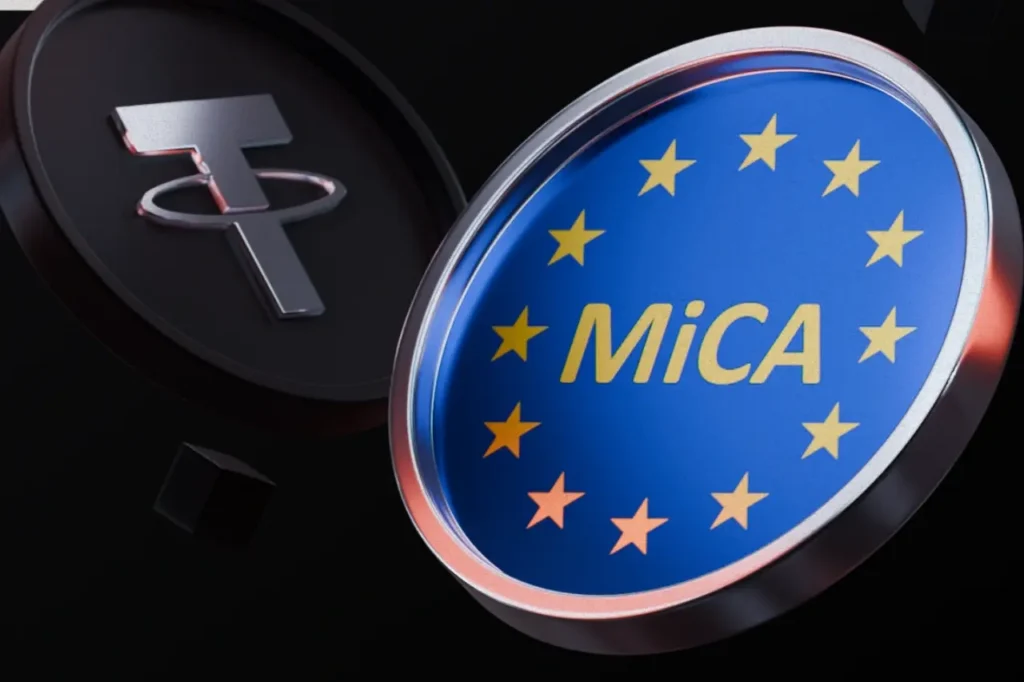
Under the European Union’s crypto regulatory framework, known as MiCA, major changes have been made across the stablecoin sector. Tether’s $USDT has been delisted from several licensed platforms operating within the European Union, including Binance, Coinbase, Kraken, and Crypto.com.
Summary:
- The European Union enacted the Markets in Crypto-Assets (MiCA) law to delist non-compliant stablecoins like Tether (USDT).
- Major platforms like Binance, Coinbase, Kraken, and Crypto. com has restricted or removed USDT from trading in the EU under MiCA rules.
- Tether’s USDT is the largest stablecoin globally with a market capitalization of around $175 billion.
Reason for the EU’s Order to Delist USDT
MiCA enforces strict policies for stablecoins. It mandates that stablecoins be pegged to a single fiat currency. They will be classified as Electronic Money Tokens (EMTs). Stablecoins must comply with licensing and reserve requirements to be available on major trading platforms. Issuers should hold 1:1 reserves and store at least 60% of them in designated EU banks. The final date for transition is July 1, 2026. Exchanges offering unauthorized stablecoins will face severe statutory penalties and potential loss of operational licenses.
The delisting comes as Tether decided not to restructure its reserve practice to comply with MiCA’s strict requirements. This move could significantly impact the region’s crypto industry. USDT is the largest stablecoin worldwide, with a market capitalization of approximately $175 billion.
Major Exchanges On Board With the Compliance Standards
Exchanges like Coinbase and Kraken delisted the $USDT trading pair for EU users. On the other hand, Binance and Crypto.com implemented geofencing measures.
This move has reduced the number of stablecoins on several licensed exchanges. Therefore, only regulated assets are used for liquidity as MiCA implements stricter guidelines. Until now, USDT has mainly been used for liquidity across several crypto ecosystems. After the delisting, it could impact and reshape the trading activities and liquidity distribution across multiple assets.
MiCA Regulation Changing EU Crypto Industry
The Markets in Crypto-Assets (MiCA) regulation was introduced to regulate digital assets and bring uniformity across EU member states, crypto service providers, stablecoin issuers, and trading platforms. It aims to improve overall transparency, reduce systemic risk, and protect users in a rapidly evolving industry. Stablecoin issuers must comply with strict requirements regarding asset backing, disclosure, governance, and regulation.
USDC Becomes a MiCA-Compliant Alternative
With USDT’s exit from the EU market, Circle’s USDC has become an alternative. USDC has positioned itself as a dominant dollar-backed token in Europe after securing MiCA approval and is available on licensed exchanges. This could strengthen the stablecoin’s role as a go-to settlement asset within regulated crypto environments.
Exchanges Gear Up As Closing Date Approaches
July 1 is the deadline set for crypto exchanges to comply with the new MiCA regulations. As mentioned, several platforms, including Binance Coin, Coinbase, Kraken, and Crypto.com, have been updating their products to comply with MiCA requirements.
Exchanges started delisting non-compliant stablecoins, updating trading pairs, and restructuring liquidity pools. These steps are also essential for exchanges to operate smoothly and legally within the European jurisdiction.
Mixed Market Reaction After USDT Delisting
The delisting of USDT from EU-regulated exchanges brought mixed reactions across the crypto industry. People supporting MiCA said that such regulations ensure clarity and stability across the European digital market. They also think that such standardized compliance could drive institutional investors and reduce systemic risks associated with unclear regulations.
On the other hand, market critics said that restricting access to the most popular and widely used stablecoin could affect liquidity and cause operational complexity for both traders and exchanges.
Final Thoughts
The European markets are bracing for the evolution of the crypto industry. With the introduction of MiCA, the European Union aims to position itself as a leader in regard to digital asset regulation and oversight. As part of this new regulatory shift, USDT has been delisted from major exchanges, and USDC is likely to become the next leading stablecoin across the EU. The compliance deadline is set for July 1; the transition period will be highly critical for exchanges, issuers, and investors as they adapt to the new requirements. This new regulatory requirement may possibly influence other regions’ approach to stablecoins.